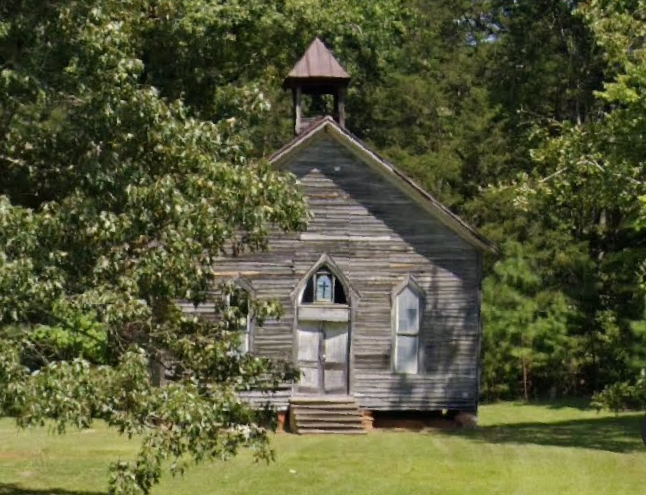
Mulberry Chapel in Pacolet
Mulberry Chapel is located at 582 Asbury Road (S.C. Highway 211), roughly eight miles northeast of Pacolet, in the Asbury community of rural Cherokee County. The chapel was built circa 1880 — soon after the American Civil War — marking it as one of the first independent African-American churches established in the South Carolina upcountry during the Reconstruction era. Its founding reflects a broader social shift: formerly enslaved people and free Black residents sought to worship separately and openly. Before the Civil War, many Black individuals in the area had attended a nearby white church (the old Asbury Methodist Church).
Local oral history holds that the land for the chapel was donated by a white landowner (referred to as Major Jack Littlejohn), under the condition that the congregation clear the ground and pick cotton on the plot — a symbolic shift from slavery to independent community ownership. The chapel is a one-story frame church built in a vernacular Gothic Revival style. The building is described as “two-bay wide by three-bay deep,” with a gable-front roof. The façade features a double-leaf central entry with a pointed-arch transom set within a steeply pitched wooden surround; flanking the central entry are two steep-headed windows.
Inside, the church is modestly outfitted: visitors have noted simple pews and a stained-glass window with a cross motif above the front door — a later addition by a community member — which may have replaced an earlier window. A belfry (bell tower) still stands atop the roof, and the original bell remains. The property includes a cemetery: roughly 20 marked graves and “20 or more” unmarked graves. Headstones date from 1888 to the 1960s, showing the church remained a burial ground for generations. Many buried there are believed to have been former slaves or descendants thereof — evidence of the congregation’s roots in emancipation and Reconstruction.
Notably, the cemetery includes the grave of Samuel Nuckles — a former slave who served as a delegate to the 1868 South Carolina Constitutional Convention and represented Union County in the State House of Representatives from 1868 to 1872. Mulberry Chapel stands as a rare surviving example of a Reconstruction-era African-American church in the upcountry of South Carolina; there are very few such extant churches from that first 25 years after the Civil War.
The chapel represents a critical shift in Black self-determination: after emancipation, newly freed African Americans sought their own congregations — not just social, but spiritual autonomy — rather than attending white-controlled churches. Though regular worship services reportedly ended in the 1940s, the church — and especially its cemetery — remains a powerful symbol of heritage, resilience, and community memory for descendants and local history-minded residents.
The entire site (church + cemetery) was officially recognized when Mulberry Chapel was listed on the National Register of Historic Places on June 27, 2012.