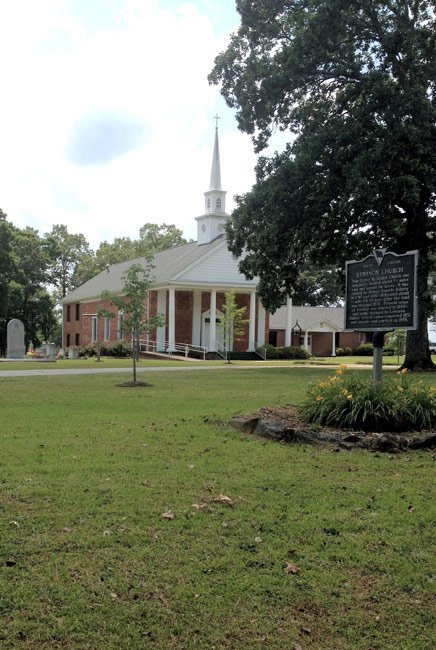
Lebanon United Methodist Church
Lebanon United Methodist Church occupies a quiet rural setting southeast of Honea Path, its white-painted sanctuary rising modestly above a landscape shaped by generations of agricultural life. The property presents a cohesive historic character, anchored by the church’s simple yet dignified frame construction and complemented by the surrounding cemetery that documents the community’s lineage across more than a century.
The sanctuary, constructed in the late nineteenth or early twentieth century, reflects the architectural vocabulary common to Methodist congregations in the South Carolina Upcountry—rectangular in plan, clad in weatherboard siding, and crowned with a front-gabled roof. Its façade is organized with restrained symmetry, typically featuring a central double-leaf entrance flanked by tall, narrow sash windows that illuminate the nave. The absence of excessive ornamentation underscores the Methodist emphasis on clarity, order, and the unobstructed gathering of the faithful. Subtle details—such as cornerboards, simple eave returns, or modest vernacular trim—lend the building a quiet refinement that speaks to the craftsmanship of local builders.
Within, the sanctuary retains its historic plan: a single-room worship space arranged with wooden pews, a raised chancel, and traditional pulpit furnishings. Natural light streams through original or early-period windows, their clear glass linking the congregation to the rural landscape beyond. The building’s materials and workmanship embody the modest resources and communal labor typical of small Upcountry congregations, where families often contributed timber, carpentry, or decorative touches as acts of devotion.
The church grounds contribute significantly to the property’s historic character. Mature trees, open lawns, and the adjacent cemetery create a setting that reflects long-standing patterns of rural worship. The burial ground, with monuments spanning multiple generations, provides tangible evidence of the congregation’s continuity and the interwoven histories of local families. Together, the church and cemetery illustrate the enduring role of Methodist institutions as spiritual and social centers in dispersed farming communities.
Lebanon United Methodist Church is significant for its association with the religious development of Anderson County and for its architectural representation of rural Methodist design traditions. The property embodies the cultural values, craftsmanship, and community identity of the Honea Path area from the post-Reconstruction era through the twentieth century. Retaining its historic form, materials, and setting, Lebanon United Methodist Church stands as a well-preserved example of the understated yet meaningful ecclesiastical architecture that shaped the Upcountry’s religious landscape.