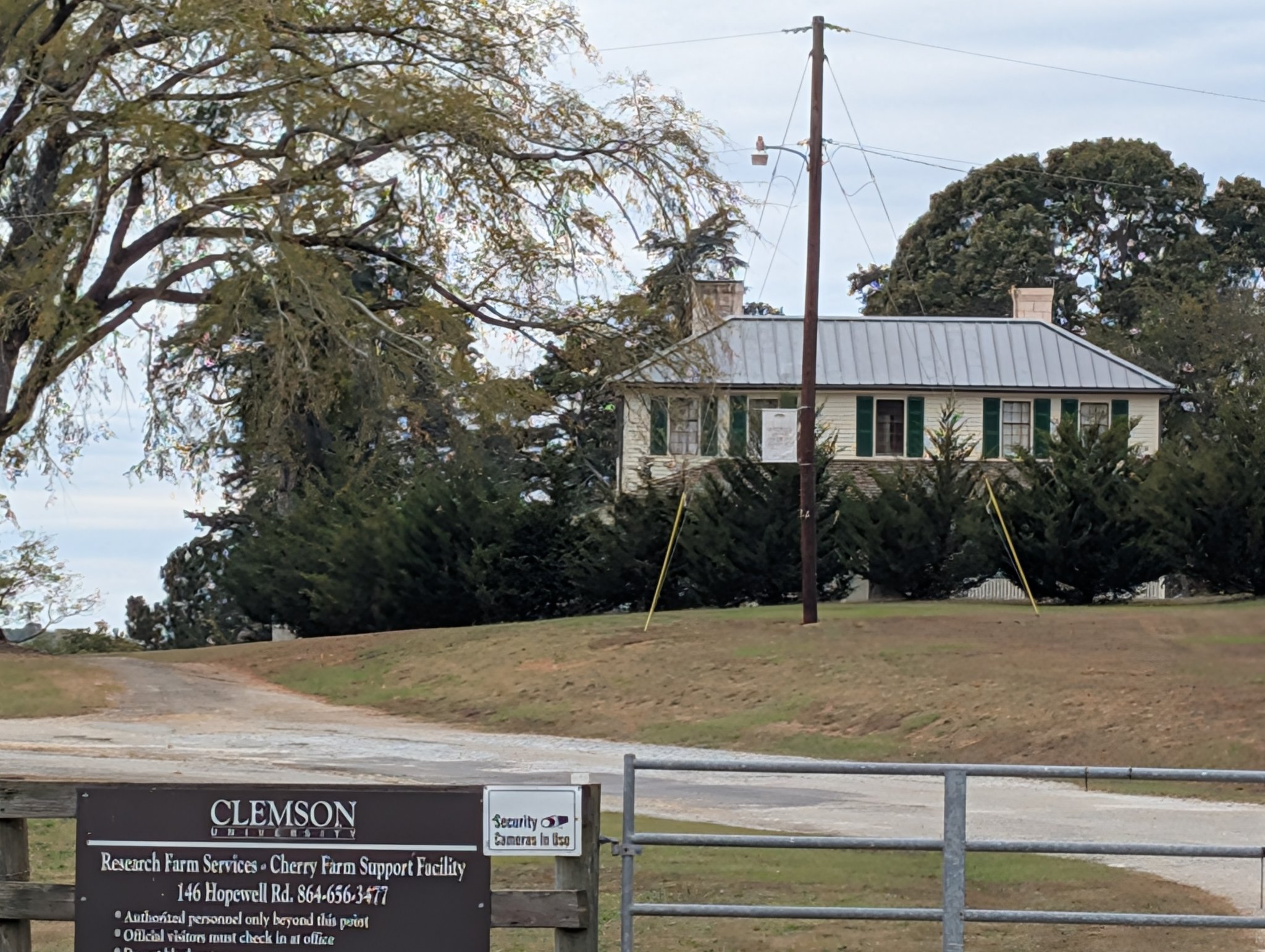
Hopewell Plantation House
Hopewell Plantation House, located near Clemson, South Carolina, stands as a tangible reminder of the early frontier period in the South Carolina Upcountry and of the region’s deep historical roots preceding the establishment of Clemson University. Built around 1785 by General Andrew Pickens—one of South Carolina’s prominent Revolutionary War leaders—the house embodies both the promise and complexity of post-Revolutionary settlement in the backcountry.
Constructed of hand-hewn timbers with a simple yet refined Georgian-inspired design, the Hopewell house originally served as the center of Pickens’ extensive plantation. Its straightforward two-story frame, gabled roof, and symmetrical façade reflect the early adaptation of Tidewater architectural traditions to frontier craftsmanship and materials. Inside, the house featured spacious rooms and modest decorative elements that balanced frontier utility with a sense of cultured domestic life.
Hopewell’s historical significance reaches far beyond architecture. It was here, in 1785, that General Pickens hosted negotiations between the new United States government and the Cherokee Nation—resulting in the Treaty of Hopewell, which established boundaries and sought to define relations between settlers and Native Americans in the region. Though the treaty was short-lived and often violated, it remains one of the earliest examples of U.S.–Cherokee diplomacy and a pivotal moment in the nation’s early expansion.
Over time, Hopewell became a symbol of transformation in the Upcountry—from a rugged frontier to an agrarian heartland, and eventually part of the lands that would form Clemson University. Though only traces of its original plantation grounds remain, the Hopewell House continues to evoke the intertwined legacies of war and peace, ambition and displacement, that defined the early American South. It stands today as a quiet but eloquent witness to the formative years of South Carolina’s—and the nation’s—frontier history.