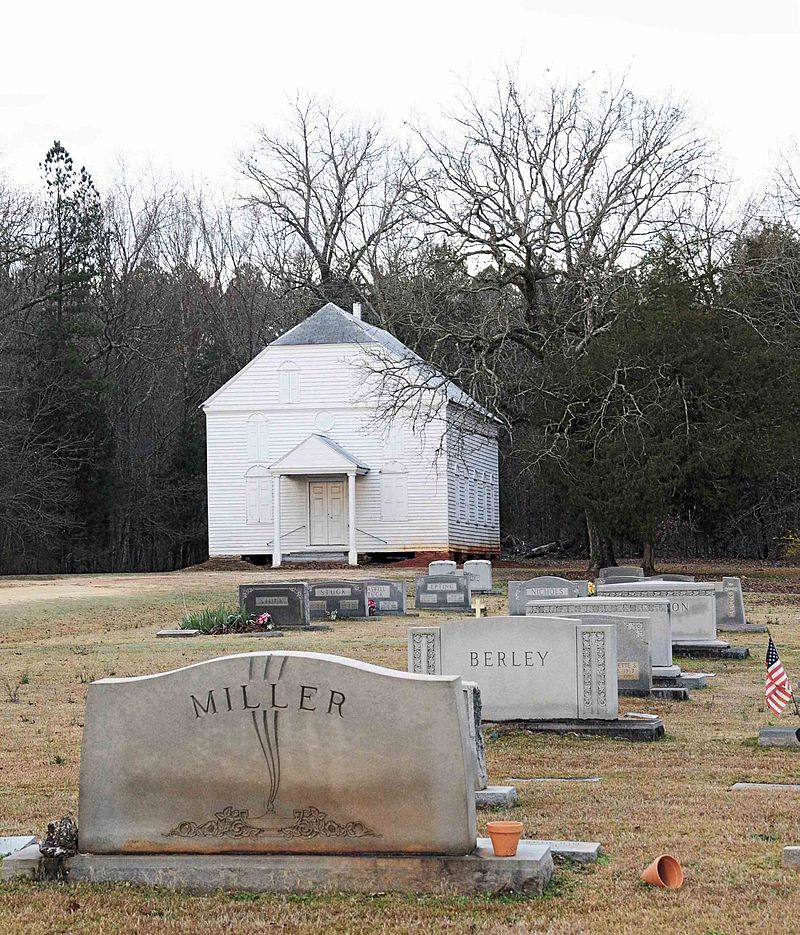
St. John’s Lutheran Church in Pomaria
St. John’s Lutheran Church, located at 622 Hope Station Road in Pomaria, South Carolina, stands as a testament to the enduring legacy of early German and Swiss settlers in the Dutch Fork region. Established in 1754 by Reverend John Gasser, the congregation initially worshipped in log cabins before constructing its first frame church in 1809. This building, often referred to as the “Old White Church,” is recognized as the oldest frame Lutheran church in South Carolina and was added to the National Register of Historic Places on December 8, 1978.
Architecturally, the church reflects a more sophisticated design than typically found in rural 19th-century churches in South Carolina. Notable features include beaded siding, a dentilled cornice, and a jerkin-head tin roof. The front façade showcases paneled entrance doors with an arched panel above and an unusual configuration of windows with matching pairs in three successive tiers. The interior boasts a wooden barrel-vaulted ceiling and wide board walls, with narrow wooden stairways in the front corners providing access to a slave gallery.
The church’s historical significance extends beyond its architecture. In 1763, the elders of the Dissenting Congregation of Crim’s Creek were granted 100 acres of land for a glebe and church building. This site became home to St. John’s Lutheran Church, underscoring its deep-rooted connection to the community and the land. Additionally, the church served as a center for education, with a school operated by St. John’s until 1921. A small, rectangular mid-nineteenth-century clapboard school building is located east of the church, within the nominated acreage.
Today, St. John’s Lutheran Church continues to serve as a place of worship and community, preserving the rich heritage of the Dutch Fork area. Its historical and architectural significance offers a window into the past, reflecting the faith, resilience, and cultural contributions of its founders and their descendants.