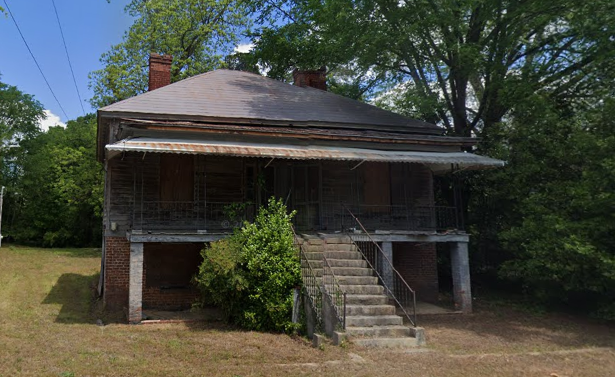
Stephenson Cottage in Newberry
The Stephenson Cottage in Newberry stands as a charming example of early 20th-century Southern residential architecture, reflecting both the craftsmanship of its builders and the understated elegance favored by its original occupants. Nestled within a historic neighborhood, the cottage conveys warmth, proportion, and a welcoming presence, embodying the domestic ideals and architectural tastes of Newberry’s middle-class families during a period of growth and civic pride.
The one- to one-and-a-half-story frame structure is defined by a gently pitched roof and a modest front-facing gable, giving the façade visual interest while maintaining an approachable scale. A cozy front porch extends across the entrance, supported by simple wooden posts and accented with restrained trim, serving as both a shaded retreat and a social threshold that connects the interior of the home with the rhythms of the surrounding neighborhood. Windows are carefully proportioned, allowing natural light to illuminate the interior while establishing balance and harmony across the exterior.
Ornamental detailing on the Stephenson Cottage is applied with elegance and restraint. Bracketed eaves, subtle gable trim, and refined porch elements enhance the visual appeal without overwhelming the structure’s modest proportions. Inside, the cottage offers a functional layout with well-proportioned rooms, high ceilings, and finely finished woodwork that create a comfortable and inviting domestic environment.
Historically, the house is associated with the Stephenson family, whose presence and contributions were part of Newberry’s social and civic life. Though modest in scale, the residence embodies the aspirations and everyday lives of its occupants, offering insight into the domestic culture and architectural traditions of the town’s early 20th-century neighborhoods.
Today, the Stephenson Cottage endures as a valued component of Newberry’s architectural heritage. Its porch, gables, and carefully executed details continue to convey the skill, taste, and care of its builders, providing a tangible connection to the town’s historic streetscape and the generations who shaped its social and architectural fabric.