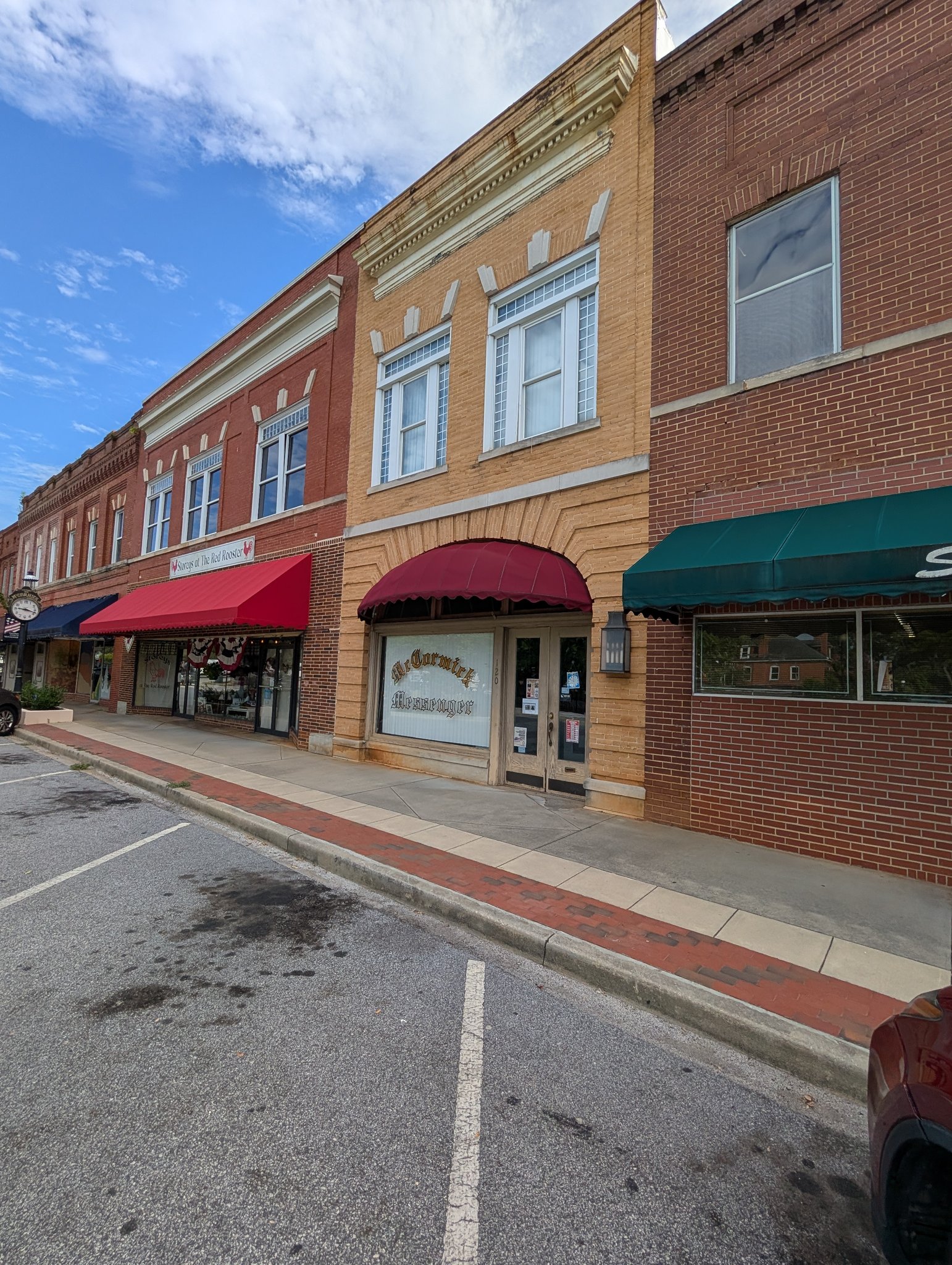
Farmer’s Bank building
Rising proudly on Main Street at 120 South Main, the Farmer’s Bank building is a dignified two-story structure built around 1911 in the Classical Revival style. Rendered in a blend of wood frame and brick, it features a commanding first-floor storefront framed by a large rounded arch, complete with radiating voussoirs and bold quoins, lending it an air of permanence and gravitas in the heart of McCormick’s early‑20th-century commercial district.
Above the arch, the second story presents two tall sash windows crowned with jack arches and keystones. These are flanked by slender sidelights and transoms in a refined “English Jack” style. A decorative sheet‑metal cornice—with dentils—caps the façade, adding a flourish of classical detail to the utilitarian block.
The bank itself was chartered in 1907 and quickly became one of only two financial institutions in early McCormick. Its predecessor building succumbed to a devastating downtown fire in February 1910, and this edifice replaced it the following year—a confident statement of resilience and civic optimism as the town rebuilt in brick and mortar.
By 1916, with assets reaching approximately $25,000, Farmer’s Bank had established itself as a leading local financial institution, anchoring McCormick’s transformation into county seat in that same year. The bank building later became the home of the McCormick Messenger, the town’s longtime weekly newspaper, intertwining finance and civic journalism under one roof.
Interior features—including the original staircase and a functional vault—remain intact, offering a glimpse into the everyday operations of early 20th-century banking and local enterprise.
Acknowledged for its architectural and historical significance, the building was added to the National Register of Historic Places on December 12, 1985 (reference #85003343), preserving it as a vital symbol of McCormick’s post‑fire renewal and early countyhood period.
In essence, the Farmer’s Bank building is more than just brick and arch—it’s a storybook in masonry. With its classical façade, surviving vault, and dual legacy as both bank and newspaper hub, it quietly narrates the rise of McCormick’s commercial district, civic pride, and resilience through early‑20th‑century upheaval.