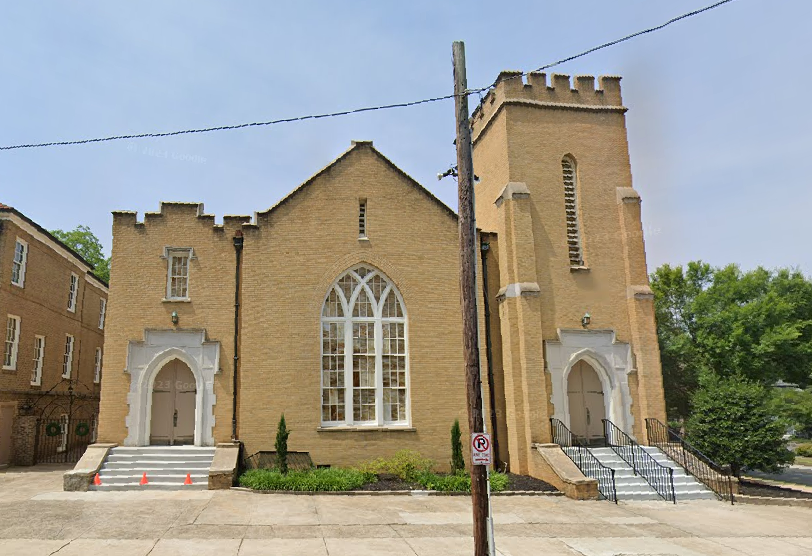
Central Baptist Church
Central Baptist Church in Greenville, South Carolina, is a historic African‑American congregation once rooted in the Hampton–Pinckney neighborhood—a cornerstone of religious and community life building over time into something profound.
Founded in November 1887, the church began humbly as a Sunday school meeting in a vacant storefront on Buncombe Street. What started as a small mission effort blossomed into Rutherford Street Church, organized with around 89 members by May 7, 1891. The congregation flourished under early leadership from missionaries like Rev. T. M. Galphin and pastors such as W. T. Hundley and Dr. D. W. Key.
By 1903–1904, generous heirs of the McBee family donated a lot at the corner of Lloyd and Pinckney Streets. A handsome brick church in Gothic‑Revival style—featuring a square castellated tower, lancet windows, buttresses, and stone‑framed arched doorways—was erected and dedicated on May 7, 1904, at which point the congregation formally adopted the name Central Baptist Church.
Architecturally, the one‑story brick building—with its Gothic arched semi‑stained glass window and fortress‑like tower—stands as an elegant local example of early‑20th‑century ecclesiastical design. It occupies a prominent place within the Hampton–Pinckney Historic District, one of Greenville’s earliest trolley suburbs and its first district listed on the National Register of Historic Places.
The church became a launching point for other congregations: in 1922, the outreach ministry that founded Earl Street Baptist began under its auspices. However, over the decades Central Baptist’s membership declined, and in 2002 it merged with Earl Street. While the original building now houses multiple congregations—Radius Greenville in the sanctuary and Crach Church in the education wing—it remains vibrantly in use, retaining continuity with its spiritual origins.
Though Central Baptist no longer functions under its original name, its building remains a testament to Greenville’s African-American religious heritage, architectural legacy, and community network. From a seed planted in a storefront classroom to a solid Gothic‑Revival edifice at the heart of a historic neighborhood, its story echoes in both structure and spirit—a rooted chapter in the city’s ongoing narrative.